12 Bible Verses on Comfort Against Anxiety and Fear
Twelve Bible verses from the Douay-Rheims translation, chosen for moments of anxiety and fear, with a note on how to read them.
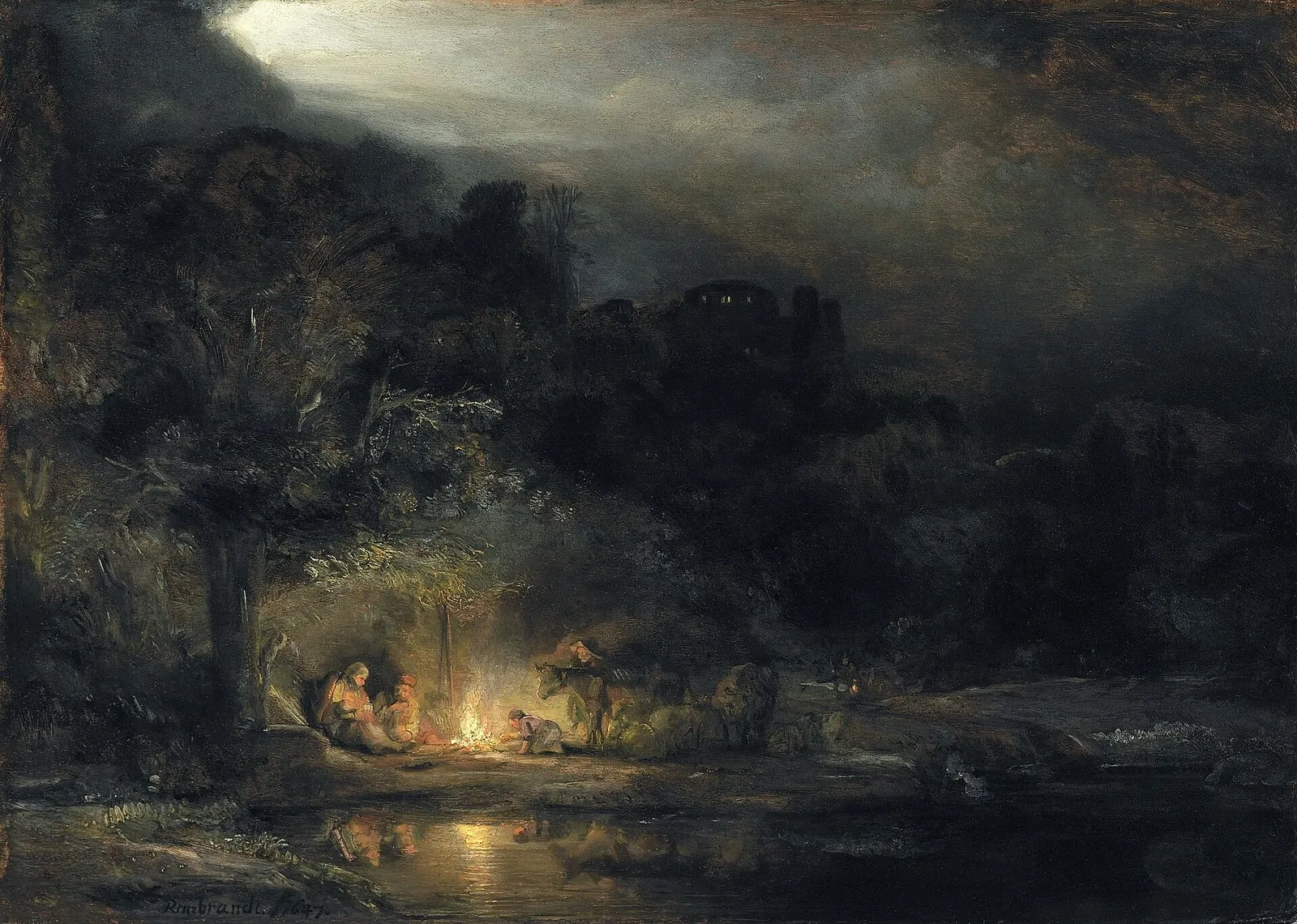

Anxiety is not overcome by reasoning. Whoever knows it knows that it comes without asking permission, often at night, and that explanations and advice are of little use. Scripture does not offer explanations. It offers words to repeat, when our own are not enough.
The twelve verses that follow speak of fear, of waiting, of weariness. They are all from the Douay-Rheims translation, the English of the Vulgate that English-speaking Catholics have read from the eighteenth century into the twentieth. It is a language broader than ours, with words we no longer use: dismayed, tribulation, faint. It is worth reading slowly.
The reasons we publish this translation, and not the one heard at Mass, are explained in Sources and rights.
The twelve verses
1. Psalm 22:4
For though I should walk in the midst of the shadow of death, I will fear no evils, for thou art with me. Thy rod and thy staff, they have comforted me.
Psalm 22:4 (Douay-Rheims)
It is the verse read to the sick and to those who accompany a dying person. The shepherd does not promise to avoid the dark valley: he crosses it, and stays beside us. The rod and the staff are the tools of one who leads a flock; here they comfort, that is, they give strength. Whoever prays these words does not receive an explanation of suffering. He receives the company of one who does not go away.
2. Psalm 26:1
The Lord is my light and my salvation, whom shall I fear? The Lord is the protector of my life: of whom shall I be afraid?
Psalm 26:1 (Douay-Rheims)
The psalm begins with two questions, not with an answer: whom shall I fear, of whom shall I be afraid. Whoever is afraid can repeat them without resolving them. The light and the salvation are not yet visible, and yet the psalmist declares them before he sees them. It is the gesture of one who enters the dark stating that the dark is not everything.
3. Psalm 33:18
The Lord is nigh unto them that are of a contrite heart: and he will save the humble of spirit.
Psalm 33:18 (Douay-Rheims)
The verse does not say that the afflicted heart heals quickly. It says where God stands while the heart is afflicted: nigh. Not far off, not waiting for it to pass. Whoever prays with a broken heart does not first have to mend it in order to be heard.
4. Psalm 45:2
Therefore we will not fear, when the earth shall be troubled; and the mountains shall be removed into the heart of the sea.
Psalm 45:2 (Douay-Rheims)
The psalm does not deny the earthquake: it puts it in the very first verse, together with the mountains that fall into the sea. The sentence begins, however, with a “therefore we will not fear”, which comes before the catastrophe. It is a trust that does not depend on how things go.
5. Psalm 90:1-2
He that dwelleth in the aid of the most High, shall abide under the protection of the God of Jacob. He shall say to the Lord: Thou art my protector, and my refuge: my God, in him will I trust.
Psalm 90:1-2 (Douay-Rheims)
Here it is not a distant God that is spoken of, but a shelter: whoever rests in the aid of the most High stands under a protection that is not seen. The following verse is a reply in the first person, as if the psalmist were answering his own fear. In tradition this is the psalm of protection, together with the invocation Under thy protection.
6. Psalm 120:1-2
I have lifted up my eyes to the mountains, from whence help shall come to me. My help is from the Lord, who made heaven and earth.
Psalm 120:1-2 (Douay-Rheims)
The psalmist lifts his eyes to the mountains, which for Israel were both the road and the danger. The question remains suspended: from whence help shall come to me. The answer does not come from the mountains, but from the one who made heaven and earth. Whoever today looks up and finds nothing can repeat the second verse alone.
7. Deuteronomy 31:6
Do manfully and be of good heart: fear not, nor be ye dismayed at their sight: for the Lord thy God he himself is thy leader, and will not leave thee nor forsake thee.
Deuteronomy 31:6 (Douay-Rheims)
Moses speaks to a people about to enter an unknown land without him. The verb is in the future and sets no conditions: he will not leave thee, nor forsake thee. This does not depend on how good we are at remaining faithful.
8. Josue 1:9
Behold I command thee, take courage, and be strong. Fear not and be not dismayed: because the Lord thy God is with thee in all things whatsoever thou shalt go to.
Josue 1:9 (Douay-Rheims)
God repeats to Josue an order already given. The repetition says that fear is not a defect to hide, but something one lives with. The reason for courage does not lie in the character of Josue, but in a presence: the Lord thy God is with thee in all things whatsoever thou shalt go to. Even in places we have not chosen.
9. Isaias 41:10
Fear not, for I am with thee: turn not aside, for I am thy God: I have strengthened thee, and have helped thee, and the right hand of my just one hath upheld thee.
Isaias 41:10 (Douay-Rheims)
Three imperatives and three reasons. Fear not: for I am with thee. Turn not aside: for I am thy God. Then the past, with three verbs in crescendo: I have strengthened thee, I have helped thee, and upheld thee. The verse does not promise that nothing bad will happen. It promises that it will not happen alone. You can read the prophet’s entry on Isaias.
10. Isaias 43:2
When thou shalt pass through the waters, I will be with thee, and the rivers shall not cover thee: when thou shalt walk in the fire, thou shalt not be burnt, and the flames shall not burn in thee.
Isaias 43:2 (Douay-Rheims)
Water, river, fire, flame. The text does not say that we will be spared the elements: it says that we will pass through them. Faith is not a bridge over troubles, it is the certainty of a presence within troubles. Isaias writes to deportees, people who knew the fire of burnt cities.
11. Isaias 40:31
But they that hope in the Lord shall renew their strength, they shall take wings as eagles, they shall run and not be weary, they shall walk and not faint.
Isaias 40:31 (Douay-Rheims)
Just before, the prophet lists those who grow weary: the young, the strongest. Weariness is not a shame. The verse does not promise wings to fly away from problems, but strength to walk. They shall run and not be weary, they shall walk and not faint: even the slow step falls within the promise.
12. Jeremias 29:11
For I know the thoughts that I think towards you, saith the Lord, thoughts of peace, and not of affliction, to give you an end and patience.
Jeremias 29:11 (Douay-Rheims)
These are words written to deportees in Babylon, to whom God has just announced seventy years of exile. Hope does not cancel the waiting: it passes through it. The verse does not say that the future will be what we had imagined; it says that God’s thoughts towards us are thoughts of peace.
How to read a verse when you are anxious
It is not a study, and it is not an exam. When anxiety tightens, reading changes compared with when we are well.
One only. One verse is chosen, not twelve. Twelve are too many: the anxious mind needs few fixed words, repeated.
Aloud, slowly. The psalm of protection says:
He shall cry to me, and I will hear him: I am with him in tribulation, I will deliver him, and I will glorify him.
Psalm 90:15 (Douay-Rheims)
The words are to be said, not only thought. The voice helps the body to slow down. If the evening is the hardest moment, the evening prayer offers a simple structure.
Repeat. There is nothing magical in repetition. It serves to keep attention where thought does not want to stay. It is the same mechanism as the Chaplet of the Divine Mercy, which entrusts to a refrain a request we do not know how to formulate.
Do not expect to feel something. In these moments faith is rarely an emotion. Often it is only an act of the will: to say these words because they are true, even without feeling them.
If fear takes the form of a thought one cannot let go of, the prayer to Saint Michael may help, traditionally tied to protection. If instead a sense of guilt weighs on us, the act of contrition is the shortest and most direct prayer.
And if the anxiety does not pass, this does not mean that the prayer did not work. The Lord does not ask us not to be afraid: he asks us to bring it to him. The Salve Regina closes with a request that is not ashamed of sorrow, and the Our Father remains the starting point of everything: one day at a time.
A note on the texts
The quotations are given as they read in the Douay-Rheims edition, without modernisations. Two cautions for whoever wants to check them.
The first concerns the numbering. The Douay-Rheims follows the Vulgate, and the Vulgate numbers the psalms differently from the numbering more common today, which goes back to the Hebrew text: the psalm of protection, for everyone “Psalm 91”, is here Psalm 90, and the same gap holds for the other psalms cited. In every reference you will find the Douay-Rheims number.
The second concerns the titles. Some psalms carry at their head an indication such as “A psalm for David” or “A gradual canticle”: it is a heading, not a verse, and we have not reported it inside the quotation.